
G.N. Ramachandran Family Tree
G.N. Ramachandran - A Lifestory
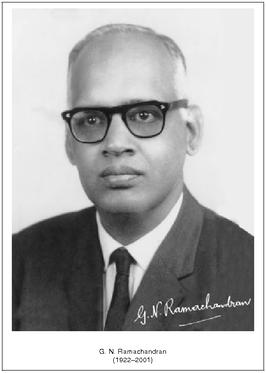
G.N. Ramachandran was a distinguished Indian biophysicist renowned for his groundbreaking contributions to the field of protein structure determination. Born in 1922 in Ernakulam, Kerala, his academic journey began with a degree in physics from Madras University, followed by a Ph.D. from Cambridge University under the guidance of W.A. Wooster. His early research focused on Xray diffraction studies of crystals, laying a solid foundation for his later work in biomolecular structure. Upon returning to India, he established a leading school of structural biology at the University of Madras.
Ramachandran's most significant contribution was the creation of the Ramachandran plot, a graphical representation depicting the allowed regions for the dihedral angles phi (φ) and psi (ψ) of amino acid residues in a protein structure. This plot, developed in the 1960s, revolutionized the validation and refinement of protein structures derived from Xray crystallography and NMR spectroscopy. It provided a simple yet powerful tool to assess the stereochemical plausibility of a proposed protein conformation, highlighting regions of steric clashes and energetically unfavorable arrangements. The Ramachandran plot continues to be an indispensable tool in structural biology, used universally to evaluate the quality of protein models.
Beyond the Ramachandran plot, he made significant contributions to collagen structure, proposing a triplehelical model that provided a detailed understanding of its unique properties. He also developed a realspace refinement method for crystal structures. His work earned him numerous accolades, including the Shanti Swarup Bhatnagar Prize, one of India's highest science awards. Ramachandran's research significantly advanced the understanding of biomolecular structures and continues to influence the field of structural biology today. He passed away in 2001, leaving behind a legacy of scientific innovation and a lasting impact on the study of proteins.
Family and Early Years
Personal Details
- 🎂 Date of Birth
- G.N. Ramachandran was born on 08 October 1922.
- 📍 Place of Birth
- He was born in Ernakulam Cochin, British India (presentday Kerala, India).
- 🎓 Educational Background
- He received his D.Sc. degree from Cambridge University.
Early Career
- G.N. Ramachandran embarked on his professional journey with a strong foundation in physics quickly transitioning to the burgeoning field of molecular biophysics, setting the stage for groundbreaking contributions.
- 🔬 Early Academic Pursuits
- Ramachandran's initial foray into the scientific world began with a Ph.D. in physics from Cambridge University. His early research involved studying the dynamic X-ray scattering by crystals.
- 🏢 Transition to Biophysics
- Upon returning to India he joined the Department of Physics at the University of Madras. This marked a pivotal shift in his career as he began applying his knowledge of physics and mathematics to biological problems. This transition was significantly influenced by his interest in understanding the structure of collagen.
- 🧬 First Major Contribution: The Ramachandran Plot
- His most significant early contribution was the development of the Ramachandran plot a graphical representation that illustrates the possible dihedral angles of amino acid residues in a protein structure. This plot revolutionized the field of structural biology by providing a simple yet powerful tool for validating and refining protein structures determined by X-ray crystallography.
- 🤯 Challenges in Establishing Recognition
- Initially Ramachandran faced skepticism from some established scientists who were hesitant to accept the application of theoretical methods to biological problems. Securing funding and resources for biophysical research in India during that time was also a considerable hurdle. He worked to advocate for the importance of this new interdisciplinary field.
A Journey of Recognition
Career Journey
- G.N. Ramachandran was a pioneering biophysicist whose Ramachandran plot revolutionized structural biology providing a crucial tool for understanding protein structure.
- 🔬 Early Career & Ramachandran Plot Breakthrough:
- After gaining recognition for his work on collagen structure G.N. Ramachandran shifted his focus to developing methods for determining the three-dimensional structure of proteins. This led to his most famous contribution: the Ramachandran plot. This plot, a graphical representation of allowed dihedral angles in protein backbones, became an indispensable tool for validating and refining protein structures determined by X-ray crystallography and other methods. This breakthrough fundamentally changed how scientists understood and analyzed protein conformations.
- 🧑🏫 Professorship & Leadership in Molecular Biophysics:
- Following the immense impact of the Ramachandran plot he established and headed the Department of Biophysics at the University of Madras. This involved building a research team, securing funding, and fostering an environment conducive to cutting-edge research in molecular biophysics. He played a crucial role in establishing India as a prominent center for biophysical research. He also held visiting professorships at various international universities, further disseminating his knowledge and influencing the global scientific community.
- 🧮 Contributions to Mathematical Biology & Image Processing:
- Beyond protein structure Ramachandran made significant contributions to other areas, including mathematical biology and image processing. He developed methods for deconvolution of blurred images, a technique with applications in various fields. This demonstrated his versatility and his ability to apply mathematical principles to solve complex problems across different scientific disciplines. His work in these areas, while less widely known than the Ramachandran plot, further solidified his reputation as a brilliant and innovative scientist.
- 🏆 Recognition & Legacy:
- Throughout his career G.N. Ramachandran faced the challenge of gaining recognition for his work, particularly in the early years. Despite this, he persevered, driven by his passion for scientific discovery. His legacy is profound. The Ramachandran plot remains a cornerstone of structural biology, and his contributions have influenced generations of scientists. He is remembered as a visionary scientist who made groundbreaking contributions to our understanding of the molecular world.
Achievements and Milestones
- Here is a list of awards received by G.N. Ramachandran:
- 🏆 Awards and Honors
- ● Shaanti Swarup Bhatnagar Award (1961)
- ● Watumull Foundation Award (1964)
- ● Fellow of the Royal Society (FRS) (1977)
- ● Fogarty International Medal NIH, USA (1999).
Additional Highlights
Contributions
- G.N. Ramachandran revolutionized the understanding of protein structure with his rigorous mathematical and physical approach to biological problems.
- 🧬 The Ramachandran Map
- ● This is arguably Ramachandran's most significant contribution. The Ramachandran map also known as the Ramachandran plot, is a graphical representation of the allowed dihedral angles (phi and psi) for amino acid residues in a protein structure.
- ● It uses steric constraints to predict which conformations are energetically favorable providing a theoretical framework for analyzing and validating protein structures determined experimentally.
- ● The map has become an indispensable tool in structural biology used to assess the quality of protein structures obtained through X-ray crystallography and NMR spectroscopy.
- 🧪 Triple Helical Structure of Collagen
- ● Ramachandran and his team were the first to propose the correct triple helical structure of collagen the main structural protein in connective tissues.
- ● This groundbreaking work published in 1955, revealed how three polypeptide chains are intertwined to form a strong, rope-like structure.
- ● Their model explained the unique amino acid composition of collagen (rich in glycine proline, and hydroxyproline) and provided insights into its mechanical properties.
- 🧮 Development of Mathematical Methods for Biomolecular Structure
- ● Ramachandran pioneered the application of mathematical and computational techniques to study the structure and conformation of biological molecules.
- ● He developed methods for conformational analysis considering the energy associated with different molecular arrangements.
- ● His work laid the foundation for the field of computational biology and bioinformatics enabling researchers to predict and model the structures of proteins and other biomolecules.
- 👓 Crystallography and Molecular Biophysics
- ● Ramachandran established a leading school of crystallography and molecular biophysics at the University of Madras (now Chennai).
- ● He trained numerous students and researchers who went on to make significant contributions to the field.
- ● His research group focused on understanding the structures of various biomolecules including peptides, proteins, and polysaccharides.
- While information on direct philanthropic activities social advocacy, or public service is not readily available, G.N. Ramachandran's cultural influence stems from his dedication to scientific education and the promotion of scientific research in India. He played a crucial role in fostering a scientific temperament and inspiring generations of Indian scientists.
Death
- G.N. Ramachandran passed away on 07 April 2001.
Disclaimer
The information provided has been gathered from various sources and may have errors or discrepancies.
If you notice any inaccuracies, please let us know at admin-support@imeuswe.in


