

Gauri Lankesh Family Tree
Gauri Lankesh - A Lifestory
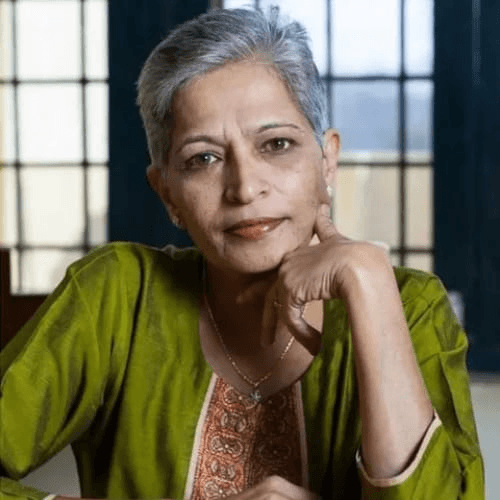
Gauri Lankesh (29 January 1962 – 5 September 2017) was an Indian journalist and activist from Bangalore, Karnataka. The daughter of noted poet-journalist P. Lankesh, she began her career with The Times of India and later worked as a correspondent for Sunday magazine. After her father’s death, she briefly edited Lankesh Patrike before launching her own Kannada weekly, Gauri Lankesh Patrike, where she fearlessly wrote on issues of caste, gender, communalism, corruption, and freedom of expression. She headed Komu Souharda Vedike, a platform promoting communal harmony, and became widely recognized as a staunch critic of right-wing Hindutva politics, while also supporting women’s rights, Dalit struggles, and the Lingayat community’s demand for minority status. Despite facing defamation suits, threats, and attacks on her credibility, she remained uncompromising in her stand for truth and justice.
On 5 September 2017, Gauri was shot dead outside her home in Rajarajeshwari Nagar, Bengaluru. Her death sparked nationwide outrage and cemented her legacy as a fearless voice of dissent. Posthumously, she was awarded the Anna Politkovskaya Award (2017) for her courage in speaking against extremism, campaigning for women’s rights, and opposing caste-based discrimination. Today, Gauri Lankesh is remembered as a symbol of resistance, whose voice continues to inspire journalists, activists, and citizens fighting for justice and democracy.
Family and Early Years
Personal Details
- 🎂Date of Birth
- 29 January 1962
- 🏡 Place of Birth
- Bengaluru, Karnataka
- 👨👩👧 Family
- Father: P. Lankesh
- Siblings: Indrajit Lankesh, Kavitha Lankesh
- Spouse: Chidanand Rajghatta
- Adopted Children: Umar Khalid, Kanhaiya Kumar, Jignesh Mevani, Shehla Rashid Shora
Early Career
- Gauri Lankesh embarked on her professional journey as a journalist, quickly establishing herself as a voice for secularism and social justice.
- 🌱 Early Life
- Gauri Lankesh was born into a Kannada Lingayat family. Her father, P. Lankesh, was a noted poet and journalist who founded the Kannada-language weekly tabloid Lankesh Patrike.
- She grew up with two siblings – Kavitha and Indrajit – in a household deeply rooted in literature and progressive ideas.
- 📰 Early Career in Journalism
- Gauri began her professional journey in journalism with The Times of India in Bangalore. Later, she moved to Delhi after marrying Chidanand Rajghatta, where she continued to pursue her career.
- 📑 Career Progression
- After her stint in Delhi, Gauri returned to Bangalore and worked as a correspondent for the Sunday magazine for nearly nine years. At the time of her father’s death in 2000, she was employed with Eenadu’s Telugu television channel in Delhi. By then, she had already spent 16 years as a journalist, earning recognition for her fearless reporting and sharp commentary.
A Journey of Recognition
Career Journey
- Gauri Lankesh was an Indian journalist-turned-activist known for her fearless and critical journalism.
- 📰 Lankesh Patrike
- After the death of her father, P. Lankesh, Gauri Lankesh, and her younger brother Indrajit initially considered shutting down Lankesh Patrike. However, the publisher, Mani, convinced them to continue. Gauri took charge as the editor, while Indrajit managed the business affairs of the paper.
- From 2001 onwards, ideological differences grew between the siblings. The dispute became public in 2005, when a report on a Naxalite attack, approved by Gauri, was published. Indrajit withdrew the report, accusing her of favoring the Naxals. This led to police complaints and press conferences where the siblings openly accused each other. Following the fallout, Gauri launched her own Kannada weekly, Gauri Lankesh Patrike, where she continued her fearless journalism.
- 🏛️ Political Views and Ideology
- Gauri was a staunch critic of right-wing Hindutva politics and openly opposed attempts by the Sangh Parivar to “Hinduise” the Guru Dattatreya Baba Budan Dargah in 2003. She actively campaigned for communal harmony and headed the Komu Souharda Vedike, which worked for the rights of oppressed communities.
- She supported giving the Lingayat community minority religion status and frequently challenged caste hierarchies, calling Hinduism a “system of hierarchy” that treated women as second-class citizens.
- Gauri’s writings often exposed wrongdoings of political leaders, including those within the Indian National Congress like D. K. Shivakumar, as well as religious leaders accused of sexual abuse such as Raghaveshwara Bharati. She strongly opposed the Bharatiya Janata Party (BJP) and even ended her decades-long friendship with Prakash Belawadi after he became a BJP media advisor in 2014.
- In 2014, the Karnataka government appointed her to a committee to encourage Naxalites to surrender, but BJP leaders demanded her removal, accusing her of being a sympathizer. The then Chief Minister Siddaramaiah rejected the demand.
- At the 2015 Kannada Sahitya Sammelana, she sparked controversy by comparing the criticism of Dalit writer Perumal Murugan with the acceptance of similar themes in Brahmin novelist S. L. Bhyrappa’s works, leading to protests from Brahmin associations.
- 📌 Defamation Conviction (2016)
- In 2008, Gauri published an article titled “Darodegilada BJP galu” that accused BJP leaders Pralhad Joshi, Umesh Dushi, Shivanand Bhat, and Venkatesh Mestry of corruption. The article led to defamation cases filed by Joshi and Dushi.
- In 2016, the Hubli JMFC court found Gauri guilty of defamation and sentenced her to six months imprisonment, along with a fine of ₹10,000.
- She was, however, granted anticipatory bail, avoiding prison time.
- Gauri insisted that her article was based on reliable sources within the BJP and described the verdict as a temporary setback, vowing to challenge it in higher courts
- 🎬 In Popular Culture
- Gauri Lankesh’s assassination has been featured in the documentary mini-series “Vivek – Reason” by Anand Patwardhan, which also highlights the killings of rationalists Narendra Dabholkar, M. M. Kalburgi, and Govind Pansare.
- The Malayalam film 19(1)(A) is loosely based on her life and work.
- 🌍 Legacy
- Gauri Lankesh continues to be remembered as a symbol of resistance against authoritarianism and communal politics.
- On her third death anniversary (2020), journalists and activists launched the #IfWeDoNotRise campaign, both in her memory and in protest against the arrests of dissidents across India.
- In 2021, the city of Burnaby, Canada, declared September 5 as “Gauri Lankesh Day”, commemorating her legacy on her death anniversary.
- In 2023, the international journalism collective Forbidden Stories carried forward her unfinished work on fake news and investigated fresh leads into her murder case as part of the “Story Killers” project.
- In 2024, American journalist Rollo Romig published the book “I Am on the Hit List: A Journalist's Murder and the Myth-Making in South India”, which examines Gauri’s murder, the investigation linking it to right-wing groups like the Sanatan Sanstha, and the broader ideological conflicts in South India.
Achievements and Milestones
- Anna Politkovskaya Award (Posthumously honored), 2017
Additional Highlights
Contributions
- 📰 Journalism & Media
- Gauri Lankesh made significant contributions to Indian journalism through her fearless reporting and editorial work. She began her career with The Times of India and later edited Lankesh Patrike before founding her own weekly, Gauri Lankesh Patrike. Through this platform, she consistently highlighted issues such as caste discrimination, women’s rights, and political corruption, giving voice to marginalized communities often neglected by mainstream media. She also championed freedom of the press and used her writings to question power structures.
- ⚖️ Social Justice & Activism
- As a social activist, Gauri Lankesh strongly opposed communal politics, caste hierarchies, and patriarchal practices. She actively supported the Lingayat community’s demand for recognition as a minority religion and served as the head of Komu Souharda Vedike, an organization promoting communal harmony. Her activism often put her at odds with powerful religious leaders and political groups, especially when she exposed sexual assault cases involving influential figures.
- 🌍 Advocacy & Resistance
- Gauri was deeply involved in advocating for social justice at the grassroots level. She resisted the attempts to Hinduise the Baba Budan Giri shrine, defended writers like Perumal Murugan who faced censorship, and consistently spoke out against intolerance and authoritarianism. She worked alongside students, Dalits, and minority groups, amplifying their struggles and ensuring their voices were heard in public discourse.
- 🕊️ Symbol of Courage
- Despite facing multiple defamation cases, threats, and smear campaigns, Gauri never backed down from her convictions. Her courage to challenge both political and religious establishments made her a powerful symbol of resistance. Even after her assassination in 2017, she continues to inspire activists, journalists, and ordinary citizens to uphold truth, equality, and democratic values.
Death
- Gauri Lankesh passed away on 05 September 2017.