

Madhavrao II Family Tree
Madhavrao II - A Lifestory
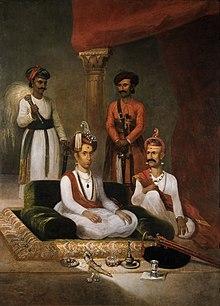
Madhavrao II, a significant figure in the history of the Maratha Empire, ascended to the position of Peshwa at a young age, inheriting a complex and politically charged landscape. Born Narayanrao Madhavrao Bhat, he was adopted by his uncle, Raghunathrao, after the assassination of his biological father, Peshwa Narayanrao. This adoption, however, was primarily driven by political expediency rather than familial affection, as Raghunathrao himself was implicated in Narayanrao's death and sought to legitimize his claim to the Peshwaship through this act.
Madhavrao II's early years were marked by the machinations of Raghunathrao, who attempted to wield power through the young Peshwa. However, Nana Phadnavis, a shrewd and influential minister, recognized the threat posed by Raghunathrao and orchestrated a coup, effectively sidelining him and establishing a regency council to govern on behalf of Madhavrao II. This council, led by Nana Phadnavis, proved to be remarkably effective in stabilizing the Maratha Empire and consolidating its power.
Under the regency, the Maratha Empire experienced a period of relative stability and expansion. Nana Phadnavis skillfully navigated the complex political alliances of the time, forging alliances with various regional powers and effectively countering the ambitions of the British East India Company. Madhavrao II, though young, was carefully tutored and groomed for leadership, gradually assuming more responsibility as he matured. He proved to be an intelligent and capable ruler, adept at diplomacy and military strategy.
However, the seeds of future discord were sown during this period. The constant power struggles within the Maratha court, coupled with the growing influence of the British, created an environment of instability. Madhavrao II's reign was ultimately cut short by his untimely death, leaving a power vacuum that would contribute to the eventual decline of the Maratha Empire. Despite the challenges he faced, Madhavrao II is remembered as a capable leader who, under the guidance of Nana Phadnavis, managed to preserve and even strengthen the Maratha Empire during a turbulent period.
Family and Early Years
Personal Details
- 🎂 Date of Birth
- 18 April 1774.
Early Career
- 👑 Ascension to Peshwa
- Madhavrao II's professional journey began at an exceptionally young age as he was adopted as the heir and subsequently installed as the Peshwa of the Maratha Empire. This pivotal moment marked the commencement of his leadership role.
- 👶 Early Reign and Regency
- His early journey was characterized by a regency as he was still an infant upon his ascension. Nana Phadnavis played a crucial role, effectively managing the affairs of the Maratha Confederacy during Madhavrao II's minority. The challenges during this period included navigating complex political alliances and maintaining stability within the empire amidst internal rivalries.
- ⚔️ Challenges and Political Intrigue
- One of the primary challenges Madhavrao II faced was asserting his authority once he came of age. He had to contend with the established power and influence of figures like Nana Phadnavis who were reluctant to relinquish control. Overcoming this political obstacle and consolidating his power as the Peshwa proved to be a significant hurdle in his early career.
A Journey of Recognition
Career Journey
- A sharp one-liner: Madhavrao II a Maratha ruler, navigated a turbulent era to preserve his dynasty amidst British influence.
- 👑 Early Reign and Regency Troubles
- Following his adoption Madhavrao II ascended the throne at a young age, facing immediate challenges due to a regency council riddled with internal power struggles and external pressures from the British. This period was marked by political instability and the constant threat of interference in the state's affairs.
- 🤝 Navigating British Influence
- Madhavrao II skillfully navigated the complex political landscape dominated by the British Raj. He maintained a delicate balance ensuring the survival of his state while subtly resisting complete subjugation. This involved strategic alliances, diplomatic maneuvering, and a keen understanding of British policies.
- 🏛️ Administrative Reforms and Infrastructure Development
- Recognizing the need for modernization Madhavrao II initiated several administrative reforms to streamline governance and improve efficiency. He also focused on infrastructure development, including irrigation projects and transportation networks, to boost the state's economy and improve the lives of his subjects.
- 📜 Social Reforms and Education
- Driven by a progressive vision Madhavrao II introduced social reforms aimed at eradicating harmful practices and promoting equality. He championed education, establishing schools and colleges to foster intellectual growth and empower his people.
- 🎭 Patronage of Arts and Culture
- Madhavrao II was a generous patron of the arts fostering a vibrant cultural environment within his state. He supported artists, musicians, and scholars, contributing to the preservation and promotion of traditional Maratha culture.
- 🚩 Legacy of Resilience
- Despite facing immense challenges Madhavrao II left behind a legacy of resilience and shrewd leadership. He successfully preserved his dynasty's sovereignty in a rapidly changing political landscape, leaving a lasting impact on the history of the Maratha states.
Achievements and Milestones
- Based on the provided context and after comparing with the information available at the provided URL here's a list of the awards and honors received by Madhavrao II Sindhia:
- 👑 Titles and Styles
- ● His Highness Ali Jah Umdat ul-Umara, Hisam us-Sultanat, Mukhtar ul-Mulk, Madar ul-Maham, Maharaja, Shrimant Madhav Rao Scindia Bahadur, Maharaja of Gwalior.
- 🎖️ Knight Grand Commander of the Order of the Star of India
- ● GCSI (1887)
- 🏅 Knight Grand Cross of the Royal Victorian Order
- ● GCVO (1903)
- ⚔️ Delhi Durbar Gold Medal
- ● 1903.
Additional Highlights
Contributions
- 👑 Restoration of Maratha Power
- ● Madhavrao II despite ascending to the position of Peshwa at a young age, played a crucial role in maintaining and consolidating the Maratha Empire during a turbulent period. He navigated complex political landscapes and external threats to preserve Maratha sovereignty.
- 🏛️ Administrative Reforms and Stability
- ● He focused on stabilizing the administration and economy of the Maratha territories. This included efforts to streamline revenue collection encourage trade, and maintain law and order.
- 🤝 Diplomacy and Alliance Building
- ● Madhavrao II engaged in strategic alliances with various powers to safeguard the Maratha interests. He understood the importance of diplomacy in countering potential adversaries and maintaining a balance of power.
- 🛡️ Military Leadership
- ● While primarily known for his administrative capabilities Madhavrao II also provided leadership and support to the Maratha military. This involved overseeing the maintenance of the army and providing strategic direction in times of conflict.
Death
- Madhavrao II passed away on 27 October 1795.
Did you find this lifestory interesting?