
Mukesh Mathur Family Tree
Mukesh Mathur - A Lifestory
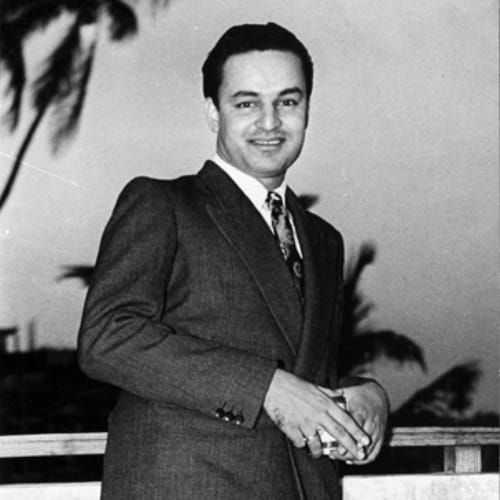
Mukesh Chand Mathur, fondly known as the “Voice of Raj Kapoor,” was born into a modest family in Delhi and went on to become one of the most loved playback singers in Indian cinema. Despite initial struggles, his soulful singing style soon carved a unique space in the film industry. His breakthrough came with Dil Jalta Hai To Jalne De in 1945, and from there he never looked back.
Through classics like Awara Hoon, Kabhi Kabhie Mere Dil Mein, and Mera Joota Hai Japani, Mukesh touched millions of hearts with his unmatched emotional depth. Winning multiple Filmfare and BFJA Awards, he became a symbol of honesty and simplicity in music. Even after his untimely passing in 1976, his songs remain immortal, making him a true legend of Indian playback singing.
Family and Early Years
Personal Details
- 🎂 Date of Birth
- 22 July 1923
- 📍 Place of Birth
- Delhi
- 👨👩👧👦 Family
- Father: Zorawar Chand Mathur
- Mother: Chandrani Mathur
- Spouse: Saral Trivedi Raichand
- Children: Rita, Nitin Mukesh, Nalini, Mohnish, Namrata
- Relatives: Neil Nitin Mukesh (Grandson)
Early Career
- 👶 Early Life
- Mukesh Chand Mathur was born in Delhi, into a Mathur Kayastha family. He was the sixth child among ten siblings of Zorawar Chand Mathur (an engineer) and Chandrani Mathur. From childhood, he showed a deep interest in music by secretly listening to his sister Sundar Pyari’s music lessons.
- He studied only up to the 10th grade and later worked at the Department of Public Works, Delhi. Alongside his job, Mukesh experimented with voice recordings and practiced instruments, gradually nurturing his love for music.
- ⚡ Struggles
- Mukesh was initially known for imitating his idol K. L. Saigal so perfectly that Saigal himself once mistook Mukesh’s song for his own recording. But this imitation also created a challenge—Mukesh had to prove his individuality.
With the guidance of Naushad Ali, he developed a distinct singing style, full of simplicity and emotional depth. - Personally, he also struggled—his marriage to Saral Trivedi faced opposition from her wealthy family, as singing in films was considered unstable. Financial difficulties in his early days made life tough, but his determination kept him moving forward.
A Journey of Recognition
Career Journey
- A legendary playback singer, Mukesh Mathur, enriched Indian cinema with his soulful voice, becoming the voice of iconic actors and emotions.
- 🎶 First Break in Films
- Mukesh’s musical journey began when Motilal, a distant relative and actor, heard him sing at his sister’s wedding. Impressed by his natural talent, Motilal took him to Bombay (now Mumbai) and arranged formal training under Pandit Jagannath Prasad. This opportunity marked the start of his career in the film industry.
- 🎬 Debut as Actor-Singer
- In 1941, Mukesh made his debut as an actor-singer in the film Nirdosh with the song “Dil Hi Bujha Hua Ho To”. His real breakthrough came in 1945 with the haunting playback number “Dil Jalta Hai To Jalne De” from the film Pehli Nazar, composed by *Anil Biswas. This song brought him into the limelight.
- 🎤 Finding His Own Voice
- During his early years, Mukesh admired and closely imitated K. L. Saigal, so much so that even Saigal himself once mistook Mukesh’s song for his own. However, under the mentorship of Naushad Ali, Mukesh gradually shaped his distinct singing style—a voice filled with pathos, warmth, and simplicity that touched millions.
- 🤝 Association with Raj Kapoor
- Mukesh’s most iconic collaboration was with Raj Kapoor, where he became the actor’s permanent playback voice. From Awara and Anari to Mera Naam Joker and Kabhi Kabhie, his songs perfectly expressed Kapoor’s on-screen emotions, creating a legendary duo remembered forever in Indian cinema.
- 🎼 Work with Legendary Composers
- Across a career spanning over three decades (1940–1976), Mukesh worked with top composers like Shankar–Jaikishan, Kalyanji–Anandji, Salil Choudhary, and Khayyam. He recorded around 1,300 songs—fewer than his contemporaries, but each carried emotional depth and artistic quality, making them immortal.
- 💖 Everlasting Melodies
- Mukesh gifted Indian cinema with timeless gems such as “Kahin Door Jab Din Dhal Jaye” (Anand), “Ek Pyaar Ka Nagma Hai” (Shor), “Sab Kuch Seekha Humne” (Anari), and “Kabhi Kabhie Mere Dil Mein” (Kabhi Kabhie). His soulful voice became the heartbeat of romance and emotion in Hindi film music.
- 🎬 Filmography
- Mukesh, the legendary playback singer and occasional actor, left behind an unforgettable legacy in Indian cinema.
- As an actor, he appeared in films like Nirdosh (1941), Aadab Arz (1943), Aah (1953), Mashooqa, and Anurag (1956). Though his acting career was limited, it was his soulful voice that made him immortal.
- As a singer, Mukesh’s journey began with Nirdosh (1941) and Ek Raat (1942), but he gained recognition with Pehli Nazar (1945). His voice became the heart of Indian cinema with timeless classics in films such as Mela (1948), Aag (1948), Suhaag Raat (1948), Vidya (1948), Anokhi Ada (1948), and Andaz (1949). The magical partnership with Raj Kapoor began with Barsaat (1949), followed by Awaara (1951), Shree 420 (1955), and Anari (1959), where his songs became anthems of an era.
- The 1960s marked his peak with unforgettable melodies from films like Jis Desh Mein Ganga Behti Hai (1960), Sasural (1961), Aashiq (1962), Bandini (1963), Dil Hi To Hai (1963), Parasmani (1963), and Sangam (1964). His voice added depth to iconic movies like Teesri Kasam (1966), Devar (1966), Upkar (1967), Milan (1967), Diwana (1967), Saraswatichandra (1968), Anokhi Raat (1968), and Saathi (1968).
- In the 1970s, Mukesh continued to reign with soul-stirring songs in Mera Naam Joker (1970), Kati Patang (1971), Anand (1971), Shor (1972), Be-Imaan (1972), Rajnigandha (1974), Roti Kapda Aur Makaan (1974), Dharam Karam (1975), Sanyasi (1975), Do Jasoos (1975), and Chhoti Si Baat (1976). His magical touch reached new heights with Kabhie Kabhie (1976), Amar Akbar Anthony (1977), and the deeply spiritual Satyam Shivam Sundaram (1978).
- Across decades, Mukesh’s voice became synonymous with romance, pain, hope, and spirituality—cementing his place as one of the greatest playback singers in the history of Indian cinema.
Achievements and Milestones
- National Film Award: "Kai Baar Yuhi Dekha Hai" – Rajnigandha – 1974
- Filmfare Awards: "Sab Kuch Seekha Humne" – Anari – 1959; "Sabse Bada Naadan" – Pehchan – 1970; "Jai Bolo Beimaan Ki" – Be-Imaan – 1972; "Kabhi Kabhie Mere Dil Mein" – Kabhi Kabhie – 1976
- Bengal Film Journalists’ Association Awards: Best Male Playback Singer – Teesri Kasam – 1967; Milan – 1968; Saraswatichandra – 1970
Additional Highlights
Contributions
- Mukesh Mathur's emotive voice and soul-stirring melodies etched an unforgettable mark on the landscape of Indian music, defining an era of heartfelt expression.
- 🎵 Musical Contributions
- Mukesh’s voice brought a new wave of simplicity and heartfelt emotion in playback singing. Unlike his contemporaries, who focused on vocal power, he emphasized soul and feeling, making his songs timeless.
- 🎬 Contribution to Indian Cinema
- He became the permanent voice of Raj Kapoor, shaping the image of the actor on screen with unforgettable songs like Awara Hoon, Mera Joota Hai Japani, and Jeena Yahan Marna Yahan. His songs became an inseparable part of Hindi cinema’s golden era.
- 🌍 Global Recognition
- Mukesh’s concerts across the world, especially in the US, UK, and Canada, carried Indian film music to international audiences, earning him global admiration.
- 🎤 Mentorship & Influence
- He inspired generations of playback singers with his distinct style, bridging the transition from K. L. Saigal’s era to modern playback singing. His songs are still studied and performed by aspiring artists.
- ❤️ Everlasting Legacy
- With over 1,300 songs, Mukesh proved that quality mattered more than numbers. His melodies continue to be played across radio, television, and live shows, keeping his voice alive in the hearts of music lovers.
Death
- Mukesh Mathur passed away on 27 August 1976.
Disclaimer
The information provided has been gathered from various sources and may have errors or discrepancies.
If you notice any inaccuracies, please let us know at admin-support@imeuswe.in


