
Nek Saini Family Tree
Nek Saini - A Lifestory
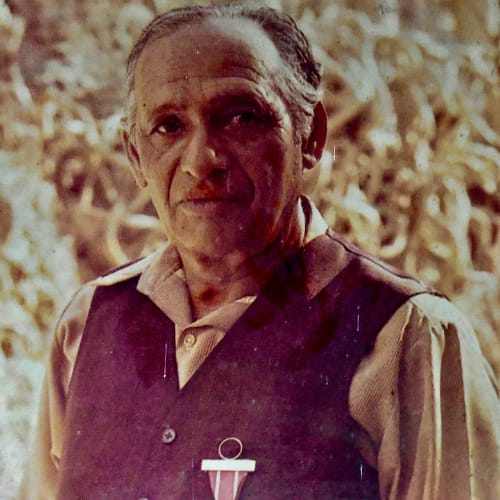
Nek Chand was a selftaught Indian artist renowned for his unique and visionary creation, the Rock Garden of Chandigarh. Born in a village near Lahore (now in Pakistan) in 1924, his family migrated to India after partition. He later worked as a road inspector for the Public Works Department in Chandigarh. It was during this time, in the 1950s, that he began his secret artistic project.
Using discarded industrial and urban waste materials like broken bangles, tiles, ceramic pots, and electrical fixtures, Nek Chand started building his garden in a government forest area. Initially working in secrecy during his spare time, he meticulously arranged these recycled materials into sculptures of humans, animals, and mythical creatures. These figures were then placed within a series of interconnected courtyards, pathways, and waterfalls, creating a surreal and enchanting environment.
For nearly two decades, Nek Chand continued his work in relative obscurity. However, in 1975, his hidden world was discovered by authorities. Instead of demolishing the unauthorized creation, the government recognized its artistic merit and provided Nek Chand with support and a team of laborers to further develop the garden.
The Rock Garden gradually expanded, becoming a popular tourist attraction and a testament to Nek Chand's artistic vision and dedication to recycling. His work gained international recognition, and he received numerous awards and accolades for his contribution to art and environmental consciousness. Nek Chand continued to work on and oversee the Rock Garden until his death in 2015, leaving behind a legacy of creativity, resourcefulness, and the transformative power of art. The Rock Garden remains a vibrant symbol of his imagination and a cherished cultural landmark in Chandigarh.
Family and Early Years
Personal Details
- 🎂 Date of Birth
- 15 December 1924
- 📍 Place of Birth
- Shakargarh Punjab, British India (now Pakistan).
Early Career
- Nek Chand Saini a self-taught artist, embarked on an extraordinary creative journey by secretly transforming a neglected government land into a fantastical rock garden using recycled materials. This clandestine activity marked the beginning of his unique artistic expression.
- 🤫 The Secret Garden Genesis
- In the initial years Nek Chand dedicated his spare time to this hidden project, meticulously collecting discarded materials like stones, broken ceramics, and industrial waste. He sculpted these materials into figures of people, animals, and mythical creatures, gradually building an elaborate world within the confines of the jungle. His early work was driven by pure passion and a desire to create beauty from waste, without any formal training or external support.
- 🚧 Discovery and First Recognition
- Nek Chand's creation remained a secret for nearly two decades until it was accidentally discovered by authorities. Instead of demolition his work was recognized for its artistic merit and ingenuity. This accidental discovery served as his "first major opportunity," transforming his secret project into a public art space.
- 🏞️ Rock Garden of Chandigarh
- The name of this debut project is the "Rock Garden of Chandigarh." This sprawling garden showcased his unique style of sculpting with waste materials and his vision of creating an imaginative world.
- 🎉 Public Acclaim and Significance
- The Rock Garden was met with widespread public acclaim. Its unique artistic vision coupled with its environmental message of recycling and reusing waste, resonated deeply with the public. It quickly became a major tourist attraction and a symbol of Chandigarh's innovative spirit.
- 🌱 Obstacles and Recognition Struggles
- In the early stages Nek Chand faced immense challenges. His work was initially considered an illegal encroachment on government land, threatening its very existence. He had to navigate bureaucratic hurdles and convince authorities of the artistic value of his creation. Lack of resources and social recognition were also significant obstacles in establishing himself and gaining acceptance for his unconventional art form.
A Journey of Recognition
Career Journey
- A self-taught artist Nek Chand Saini, transformed industrial and urban waste into the fantastical Rock Garden of Chandigarh, a unique sculptural marvel.
- 🌱 Early Recognition & The Rock Garden's Rise
- After secretly building the Rock Garden in his spare time Nek Chand's creation was discovered in 1975. Instead of demolition, the authorities were so impressed they provided him with a salary, staff, and official recognition. This marked the beginning of his career as a full-time artist and the Rock Garden's evolution into a major public attraction.
- 🧱 Expansion & International Acclaim
- Nek Chand continued to expand the Rock Garden throughout the 1980s and 90s creating new phases and adding thousands of sculptures. His work gained international recognition, with exhibitions held in Europe and the United States. He became a celebrated example of outsider art and recycling art.
- 🌍 Global Recognition & Preservation Efforts
- Nek Chand received numerous awards and honors for his work including the Padma Shri from the Indian government. Towards the end of his life, efforts were focused on preserving the Rock Garden and ensuring its continued existence as a cultural landmark. His vision continued to inspire artists and environmentalists worldwide.
Achievements and Milestones
- Here are the awards received by Nek Chand:
- 🏅 Padma Shri
- ● Awarded in 1984 by the Government of India.
Additional Highlights
Contributions
- Nek Chand Saini's transformative vision turned discarded materials into a breathtaking world-renowned rock garden, a testament to the power of individual creativity and resourcefulness.
- 🏞️ Creation of the Rock Garden of Chandigarh
- ● Nek Chand a self-taught artist, secretly began creating his Rock Garden in 1957 in his spare time, using recycled industrial and home waste.
- ● The garden sprawling over several acres, features sculptures made from discarded materials like broken bangles, tiles, ceramic pots, and electrical waste.
- ● Despite being initially unauthorized the garden gained immense popularity and was eventually adopted and supported by the government.
- ♻️ Promoting Sustainability and Recycling
- ● Nek Chand's work inherently promoted sustainability and recycling by transforming waste materials into art.
- ● His creation highlighted the potential for reusing discarded items inspiring others to think creatively about waste management.
- ● The Rock Garden itself served as a living example of environmental consciousness and resourcefulness.
- 🌍 Cultural Influence and Inspiration
- ● The Rock Garden became a major tourist attraction drawing visitors from around the world.
- ● Nek Chand's unique artistic vision inspired other artists and individuals to explore unconventional materials and techniques.
- ● His work brought international recognition to Chandigarh and contributed to the city's cultural identity.
- 🏡 Providing Employment and Community Engagement
- ● As the Rock Garden grew it provided employment opportunities for local villagers who assisted in its construction and maintenance.
- ● The garden became a community space hosting cultural events and providing a platform for local artists.
- ● Nek Chand's work fostered a sense of pride and ownership among the local community.
Recent Work
- ● Nek Chand Saini is renowned for his unique artistic vision and significant contribution to environmental art. His work continues to inspire artists and environmentalists globally.
- ● Recently Nek Chand Saini's legacy has been celebrated through the preservation and continued development of his renowned creation, which serves as a major cultural landmark and an example of sustainable art.
- ● Recent Projects:
- ● Ongoing maintenance and expansion of his primary artistic environment ensuring its preservation for future generations.
- ● Exhibitions and documentaries showcasing his life and work continue to be organized.
- ● Collaborations:
- ● Working with government and local community organizations to ensure the upkeep and promotion of his artistic environment.
- ● Partnerships with art foundations and environmental groups dedicated to preserving and promoting his unique artistic vision.
Disclaimer
The information provided has been gathered from various sources and may have errors or discrepancies.
If you notice any inaccuracies, please let us know at support@imeuswe.in

