In a world constantly seeking meaning and direction, Vedic astrology stands as a time-honoured guide rooted in divine wisdom. Also known as Jyotish Shastra, Vedic astrology is not just about forecasting the future. It’s a sacred science that illuminates your soul's journey. This ancient Indian system of astrology has helped people decode their destiny, understand their karma and make informed decisions for centuries.
Illuminating the Past: The Origins of Jyotish Shastra
The origins of Vedic astrology trace back over 5,000 years to the sacred Vedas, India’s oldest spiritual texts. Jyotish is considered one of the six Vedangas, the auxiliary disciplines associated with the Vedas, and historically focused on timekeeping and astronomical calculations for rituals.
The term Jyotish derives from the Sanskrit word jyoti, meaning “light”. It is commonly translated as the “science of light”, referring to the study of celestial bodies as symbolic indicators of earthly events.
Passed down through generations of sages and scholars, Jyotish astrology is considered a limb of the Vedas and is deeply interconnected with spiritual growth, karma and dharma.
The Sidereal Truth – How Vedic Astrology Aligns with the Stars
Unlike Western astrology, which follows the tropical zodiac based on Earth’s alignment with the seasons, Vedic astrology uses the sidereal zodiac. This system aligns zodiac signs more closely with the observable constellations in the sky.
Due to the astronomical phenomenon known as precession the gradual shift of the Earth’s axis the tropical and sidereal zodiacs currently differ by approximately 23–24 degrees. This is one of the key distinctions between Western and Jyotish astrology.
The Vedic Astrology Chart – Your Personal Blueprint
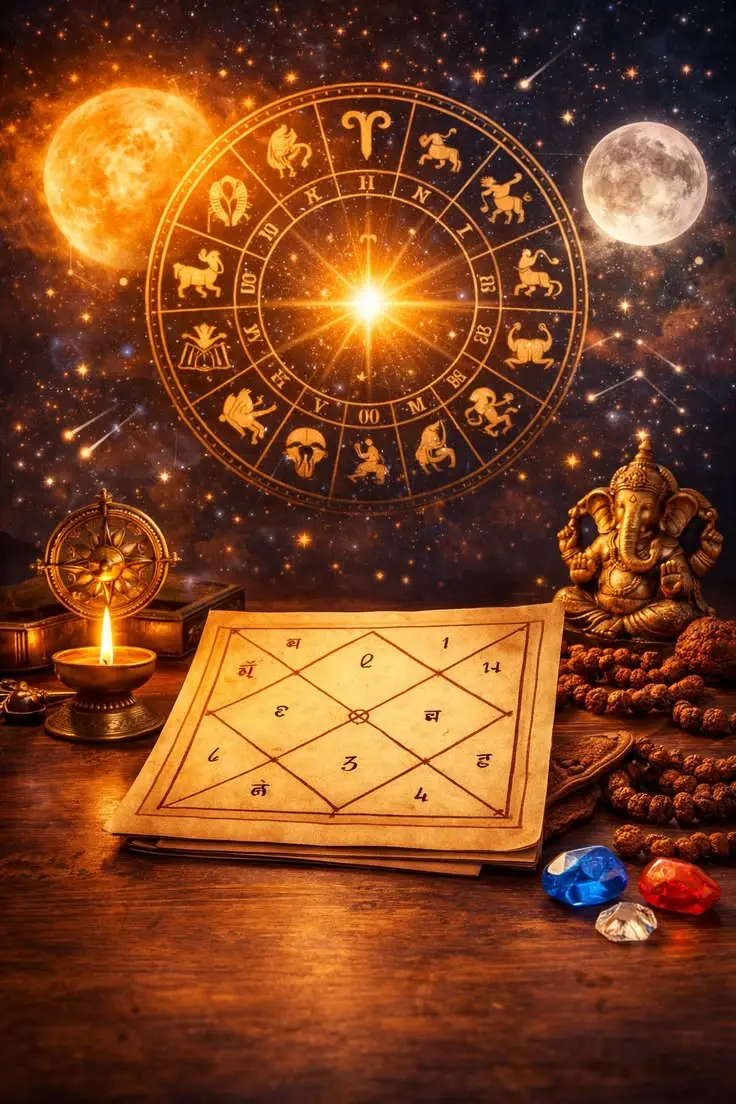
At the core of this ancient science lies the Vedic astrology chart, also known as the Janma Kundli. This chart is a celestial snapshot of the heavens at the moment of your birth, revealing your soul's karmic imprint. Just as a map guides a traveller, your Kundli serves as your personal compass, guiding you through life’s journey.
Your personalised Vedic astrology chart is structured around several core components that define various aspects of your life and destiny:
Key Elements of the Janma Kundli
- Twelve Houses (Bhavas): Each house represents a different area of life, from career and relationships to health, wealth and spirituality.
- Twelve Zodiac Signs (Rashis): These are the signs through which the planets move, influencing behaviour, temperament, and circumstances.
- Nine Celestial Influences (Navagrahas):
- Sun (Surya) – Vitality, authority
- Moon (Chandra) – Mind, emotions
- Mars (Mangala) – Energy, action
- Mercury (Budha) – Intellect, communication
- Jupiter (Guru) – Wisdom, growth
- Venus (Shukra) – Love, art, luxury
- Saturn (Shani) – Discipline, responsibility
- Rahu – The northern lunar node, associated with desires, illusions, and ambition
- Ketu – The southern lunar node, symbolising detachment, spirituality and past karma
Rahu and Ketu are not physical planets but are traditionally referred to as shadow planets. Astronomically, they are the points where the Moon’s orbit intersects the ecliptic. In Jyotish astrology, they are regarded as highly significant in karmic interpretation.
How Jyotish Astrology Works – A Balance of Karma and Free Will
Vedic astrology does not necessarily dictate fate. Rather, it offers clarity, self-awareness and tools to navigate challenges. By analysing planetary placements, transits (gochara), and planetary periods (dashas), astrologers identify timing cycles and recurring themes.
Jyotish astrology also includes remedial measures known as upayas, intended to strengthen beneficial influences or reduce challenging ones. These may include mantras, gemstones, fasting, rituals or charitable acts.
Application in Modern Times – Ancient Wisdom, Present Relevance
Despite its ancient roots, Vedic astrology continues to be practised widely in India and internationally. It addresses universal concerns such as career direction, relationship compatibility, health matters, financial stability and spiritual development.
Many individuals consult a Vedic astrology chart for guidance on selecting auspicious dates (muhurta), analysing compatibility (kundli matching), or understanding personal strengths and life cycles.
How to Get Started – Your First Step into Jyotish
If you're new to this divine science, the best place to begin is with your own birth chart. This chart is calculated using your exact birth date, time and location. This birth chart holds answers to your past experiences, present tendencies and future potential.
You can generate a basic Vedic astrology chart using an online calculator. For deeper interpretation, consulting a qualified Jyotish astrologer may provide more personalised insights.
Why Vedic Astrology Still Matters
What sets Vedic astrology apart is its depth, accuracy and spiritual richness. Rooted in the principles of karma, dharma and reincarnation, it aims not only to describe potential life patterns but also to encourage self-awareness and conscious decision-making. It's not about fearing fate; it's about understanding your karmic blueprint and using that awareness to elevate your choices and consciousness.
From spiritual seekers to those curious about their future, people continue to turn to Vedic astrology for guidance, healing and clarity. Its timeless wisdom helps individuals align with their true path and live a more harmonious, purpose-driven life.
Embracing Astrology
Whether you’re navigating life transitions, seeking clarity about your direction, or exploring ancient traditions, Vedic astrology offers a symbolic system for reflection and growth. It is more than just a predictive method, it is a structured traditional knowledge that has evolved over centuries and continues to influence spiritual and cultural practices today.