Sharad Navratri 2026 begins on 11 October and is observed for nine nights and ten days, with Vijayadashami following on 20 October. The festival falls in the Shukla Paksha of the Ashwin month and is dedicated to Shakti, the divine feminine power, with devotees worshipping the nine forms of Maa Durga known as Navadurga.
Navratri is observed differently across India, also known as Sharadiya Navratri or Ashwin Navratri. Some families follow a nine-day fast and daily puja at home, while others visit temples to perform rituals. In different parts of India, it is also observed through Garba and Dandiya, Durga Puja, Kanya Puja, devotional music and community celebrations.
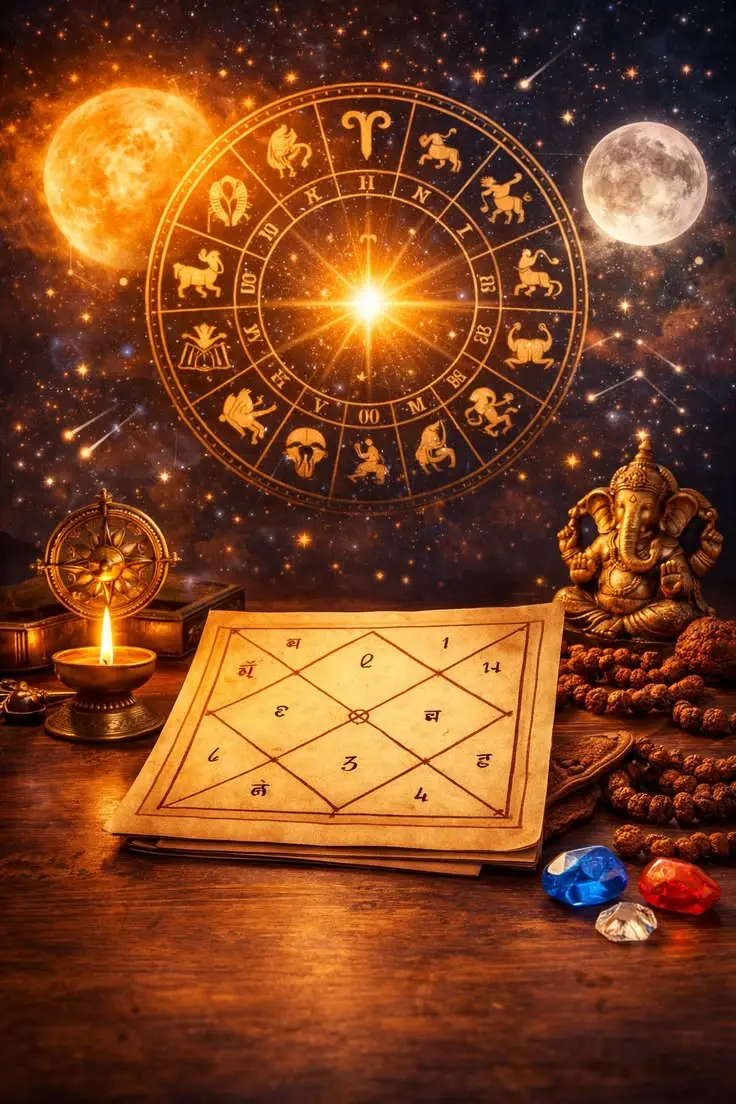
From Vedic astrology perspective, Navratri is also viewed as a period of spiritual discipline and conscious engagement with the energies represented by the Navagrahas, or nine planetary influences. However, astrology does not give one identical outcome for everyone during the festival. A personal interpretation depends on an individual's birth chart and current planetary periods and transits.
Here is a complete guide to Sharad Navratri 2026, including its dates, the nine forms of Maa Durga, traditional rituals, Navratri colours and its astrological significance.
What Is Sharad Navratri?
Sharad Navratri is the nine day festival observed during Shukla Paksha, in the Ashwin lunar month. The word Navratri comes from the Sanskrit nava, meaning nine and ratri, meaning night.
Among the four seasonal Navratris observed in the Hindu calendar, Sharad Navratri is one of the most widely celebrated. It is called Sharad Navratri because it occurs during Sharad Ritu, the autumn season.
The central focus is the worship of Devi, or Shakti. During the nine days, devotees traditionally worship nine forms of Maa Durga. Each form has its own name, iconography and traditional significance.
The festival is associated with the victory of Goddess Durga over Mahishasura in Hindu tradition. Vijayadashami, the tenth day, is also associated in many traditions with Lord Ram's victory over Ravan. The story is often understood as a representation of the victory over evil.
Navratri is not observed in exactly the same way throughout India. Gujarat and parts of Maharashtra are known for Garba and Dandiya, Bengal has the elaborate Durga Puja tradition and several communities in North and South India have their own forms of worship, fasting and devotional practice.
Sharad Navratri 2026 Dates and Important Days
According to the Panchang calculation for New Delhi, Sharad Navratri begins on Sunday, 11 October 2026, with Shukla Paksha Pratipada and Ghatasthapana. The nine-day observance reaches Durga Ashtami and Maha Navami on 19 October, while Vijayadashami falls on 20 October.
Ritual timings can differ by location, so anyone performing a specific puja should check the Panchang for their city.
| Date | Day | Navratri observance | Colour |
|---|---|---|---|
| 11 October | Sunday | Ghatasthapana, Maa Shailaputri | Orange |
| 12 October | Monday | Maa Brahmacharini | White |
| 13 October | Tuesday | Maa Chandraghanta | Red |
| 14 October | Wednesday | Maa Kushmanda | Royal Blue |
| 15 October | Thursday | Maa Skandamata | Yellow |
| 16 October | Friday | Maa Katyayani | Green |
| 17 October | Saturday | Maa Kalaratri | Grey |
| 18 October | Sunday | Maa Mahagauri | Purple |
| 19 October | Monday | Maa Siddhidatri, Maha Navami | Peacock Green |
| 20 October | Tuesday | Vijayadashami, Dussehra | Not part of the nine-day colour cycle |
The Navratri colours listed above follow the popular nine-colour tradition, where the first colour is determined by the weekday on which Navratri begins and the subsequent colours follow the established sequence. Wearing the day's colour is particularly popular in Gujarat and Maharashtra, although it is a cultural custom rather than a compulsory religious practice.
For New Delhi, the Ghatasthapana Muhurat on 11 October is 6:19 am to 10:12 am. The Abhijit Muhurat is given as 11:44 am to 12:31 pm. These timings are location-specific and can be different for every city.
Why Is Sharad Navratri Significant?
The significance of Navratri lies in its combination of devotion, symbolism and disciplined practice.
At the centre of the festival is Shakti. Worshipping Maa Durga during these nine days is traditionally seen as a way of honouring divine feminine power. The nine forms of Maa Durga also give the festival a gradual structure. Each form represents a different aspect of Shakti, allowing devotees to reflect on qualities such as courage, discipline, compassion, strength, transformation and spiritual accomplishment.
The festival also marks a transition in the seasonal calendar. Sharad Navratri takes place after Pitru Paksha and before the major festive period that includes Dussehra and Diwali.
Navratri significance also differs across India. In Gujarat, Garba and Dandiya form an important part of the celebrations. In West Bengal, Assam and parts of eastern India, the period is closely associated with Durga Puja. In several southern states, Navratri traditions include Golu or Bommai Kolu, while many northern communities observe fasting and daily Durga worship.
The 9 Forms of Maa Durga During Navratri
The nine forms of Maa Durga are known as Navadurga. The traditional sequence is Shailaputri, Brahmacharini, Chandraghanta, Kushmanda, Skandamata, Katyayani, Kalaratri, Mahagauri and Siddhidatri.
Day 1: Maa Shailaputri
Shailaputri is worshipped on the first day of Navratri. The name means daughter of the mountain, referring to Parvati as the daughter of Himavan.
She is associated with Parvati in her form as the daughter of the Himalaya. Traditionally shown riding a bull and carrying a trident and lotus, Shailaputri represents stability, strength and a grounded beginning.
The first day can therefore be approached as a reminder to establish stability before beginning any spiritual or personal transformation.
Day 2: Maa Brahmacharini
Brahmacharini represents tapasya or disciplined spiritual practice. She is traditionally depicted carrying a rudraksha mala and kamandalu.
Her form is connected with Parvati's intense tapasya, disciplined spiritual practice, undertaken to attain Lord Shiva.. The form is therefore associated with patience, devotion and sustained effort.
For a devotee, the second day can be a reminder that meaningful change usually requires consistency rather than immediate results.
Day 3: Maa Chandraghanta
Chandraghanta is identified by the crescent moon on her forehead. Her traditional imagery presents a more martial aspect of Devi.
She is associated with courage, protection and readiness to confront challenges. Her worship is associated as an opportunity to reflect on how strength can be combined with composure rather than expressed only through aggression.
Day 4: Maa Kushmanda
Kushmanda is one of the Navadurga forms associated with creative and sustaining energy. Traditional accounts connect her with the cosmic source of energy and light.
Her name is interpreted in different ways within traditional sources and she is often depicted with multiple arms carrying various divine objects. The fourth day can be used for reflecting on creativity, vitality and the ability to turn intention into action.
Day 5: Maa Skandamata
Skandamata is the mother of Skanda, also known as Kartikeya. She is traditionally depicted holding her son and seated on a lion.
Her form represents motherhood, compassion and protective strength. Worship of Skandamata can therefore be associated with compassion, responsibility and the ability to protect what matters.
Day 6: Maa Katyayani
Katyayani is a warrior form of Devi traditionally associated with the battle against Mahishasura.
Her worship is traditionally linked with courage, determination and the removal of obstacles. In some traditions, young unmarried women worship Katyayani while seeking blessings for a suitable marriage.
Day 7: Maa Kalaratri
Kalaratri is among the most formidable forms of the Goddess. Her appearance is traditionally described as fierce, yet she is also regarded as a protective form.
The contrast is important. The form is not simply about destruction. It represents confronting what is frightening or harmful and moving through it with courage.
For personal reflection, the seventh day can be associated with releasing fear and facing difficult truths.
Day 8: Maa Mahagauri
Mahagauri represents purity, calmness and renewal. She is traditionally portrayed in a peaceful form, often associated with white clothing and a white bull.
Ashtami is an important day of Navratri in many traditions. Mahagauri Puja, Durga Ashtami and, in some regions, Kanya Puja are observed on this day.
Day 9: Maa Siddhidatri
Siddhidatri is the ninth form of Navadurga. The word siddhi refers to accomplishment or attainment.
She is traditionally worshipped on Maha Navami. Her form represents the culmination of the nine-day journey and the idea of bringing spiritual effort towards completion.
In 2026, Maha Navami is observed on 19 October.
Astrological Significance of Sharad Navratri
Navratri astrology is best understood through the lunar calendar, tithis and the broader principles of Jyotish.
The festival begins on Shukla Paksha Pratipada, the first tithi of the waxing Moon. In Vedic astrology, Chandra or the Moon, has a particularly important role in understanding the mind, emotional responses and inner orientation.
This makes Navratri especially relevant to reflection and disciplined practice. The festival does not, however, mean that everyone experiences the same astrological influence.
In Jyotish, an individual's Moon sign, known as Rashi, is one of the important reference points for understanding the mind and emotional tendencies. A fuller reading may also consider the Lagna, planetary placements, Vimshottari Dasha and current transits.
Therefore, a general Navratri horoscope can offer broad themes, but it cannot replace an individual birth chart.
Navratri can also be viewed as a period for consciously working with qualities represented by different grahas. For example, Surya can be considered in relation to vitality and confidence, Chandra with the mind, Mangal with courage and action, Budh with communication and learning, Guru with wisdom and guidance, Shukra with relationships and enjoyment, Shani with discipline and responsibility and Rahu and Ketu with attachment, desire and detachment.
These are broad Jyotish themes, not fixed predictions about what will happen during Navratri. Navratri is also a period when many devotees consciously simplify their routine through fasting, prayer, meditation, mantra japa and regulated food habits.
Navratri and the Nine Planetary Energies
The idea of connecting the nine days of Navratri with the nine planetary energies can be attractive because both systems involve the number nine. The Navagrahas in Hindu astrology are Surya, Chandra, Mangal, Budh, Guru, Shukra, Shani, Rahu and Ketu.
Some modern and regional traditions create symbolic associations between the nine forms of the Goddess and the nine planetary energies. These can be useful for meditation or devotional reflection, but they should not be presented as a universal rule of Vedic astrology.
This distinction matters because Vedic astrology is chart-based. The same planetary transit can be interpreted differently depending on the houses, signs, aspects and dashas involved in an individual's horoscope.
Navratri Rituals, Puja and Practices
Navratri rituals vary according to family tradition, region and sampradaya. But several practices are widely recognised.
Ghatasthapana, also known as Kalash Sthapana, marks the beginning of the observance in many traditions. A kalash is established as part of the invocation of Devi, usually alongside other prescribed elements and prayers.
Other practices include:
- Daily worship of Navadurga
- Lighting a diya during prayer
- Reciting Durga mantras and devotional texts
- Fasting during Navratri
- Offering flowers, fruits and bhog
- Visiting a Devi temple
- Participating in Garba, Dandiya or community celebrations
- Observing Kanya Puja
- Havan or Navami Homa
- Charity and seva
Fasting is not compulsory for everyone. People who cannot fast because of age, work, pregnancy, medication, health requirements or other circumstances can observe Navratri through prayer, moderation and devotional practice instead.
When performing puja at home, it is best to follow the customs of your family or consult a priest rather than mixing rituals from unrelated traditions.
What Should You Do During Navratri?
There is no need to make Navratri complicated to make it meaningful.
Choose one daily practice that you can follow consistently. It could be a short prayer in the morning, lighting a diya, reading a devotional passage, chanting a mantra or spending a few minutes in quiet reflection.
If you choose to fast, follow a routine that is appropriate for your health and circumstances. Fasting should support spiritual discipline rather than become a source of physical distress.
Most importantly, Navratri does not need to become a period of anxiety about planetary effects or future events. Its traditional purpose is better served through devotion, awareness, discipline and reflection.
For personalised guidance, you can consult Vedic astrologers on iMeUsWe for a Navratri reading based on your birth chart.